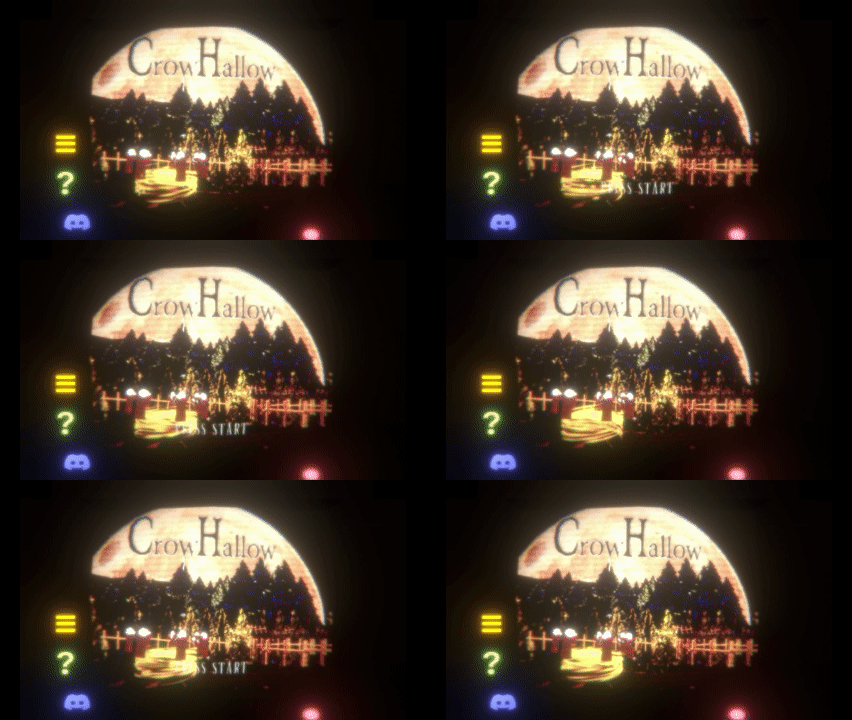
CROWHALLOW
October 2024 - December 2025
Platform: PC Engine: Unity Team Size: 9 Duration: 14 months Role: Technical Designer
Crowhallow is a single-player spooky FPS built in Unity through Drexel University’s EGS Incubator. The game centres on throwing and recalling a crow that acts as both a weapon and a utility tool, while surviving escalating enemy waves in a gothic arena.
As a Technical Designer, I focused on upgrade design, gameplay scripting, and mechanic implementation. My largest individual contribution was the crow grapple ability, which expanded the crow from a combat tool into a traversal and repositioning mechanic.
Design Pillars
Living Boomerang - The crow needed to feel like the game’s central tool.
Rogue-lite Progression - Upgrades had to give players new ways to survive longer waves without overwhelming the pick-up-and-play structure.
Gothic Arena Combat - The environment, enemy pressure, and player tools needed to support fast combat inside a spooky, readable space.
MY WORK
Designed and iterated the upgrade system structure
Implemented the crow grapple ability
Added traversal and interaction features such as ladders
Supported gameplay polish and bug fixing
MAIN MECHANICS
Shoot the Crow
Swing the Knife
Dash in the air
GAMEPLAY LOOP
The wave structure helped frame upgrade pacing around survival and decision-making. Players earned upgrade points by clearing waves, but they had to visit a brazier on the map to spend them.
This made upgrades part of the arena flow: players needed to survive enemy pressure, reach the brazier safely, and choose upgrades that supported their current run.
GRAPPLE CROW deep dive
Problem: The crow was already central to combat, but I wanted to explore how it could also support movement and repositioning. The challenge was making traversal feel connected to the existing crow mechanic rather than adding a generic grappling hook.
Design Intent: The grapple ability lets players shoot the crow toward valid grapple points and pull themselves forward, creating a faster way to reposition during combat, escape pressure, or reach elevated areas.
Implementation:
Raycast checks for valid grapple layers
Player travels toward the grapple point
Line Renderer communicates the connection
Player is pulled toward the target using tweening logic
Grapple disconnects when close enough to the grapple point
Result: The ability made the crow feel more versatile by granting it traversal functionality alongside combat once the player could obtain upgrades. It also helped reinforce the fantasy that the player’s crow is an extension of their movement kit.
WHAT I LEARNED
One lesson I learned specifically in this project came from implementing the grapple and the importance of environmental readability. While the mechanic worked functionally, I would have liked to give players clearer visual cues regarding where they could and could not grapple. In the future, I aim to use stronger affordances such as highlighted grapple points, reticle feedback, or subtle environmental shapes that communicate valid targets without deviating from the game’s aesthetic.